
The Outdoor Runner

Lessons learned from a habitual outdoor runner

Low Traction Running

snow covered ground

Photo by Pixabay on Pexels.com

This morning (Nov 15) was our first significant snow. I’m estimating 1-2 inches was on the unclear roads in the country. I have forgotten how much additional work it is to run when each step is on loose snow!

Post-run2018-11-14Before the first mile was complete, I could feel the additional energy drain. I have had to break out my heavier winter gear the last few days due to the cold wind chill (as seen on the right).  Today the temperature was in the upper 20’s with the wind in the upper teens making it a bit more bearable.

I wear layers of clothing always trying to get the proper temperature where I stay warm but not sweat excessively as to cause a chill as I deal with the wind changes. My outer layer is a lightweight coat I found at Farm and Fleet in the raincoat section. It is very water resistant and blocks the wind well. Today I had three layers under the coat and insulated wind pants, hat, gloves, and scarf.  I stayed warm but a little too warm while running with the wind. I can unzip the coat about half-way down and close the gap using the velcro tabs thus allowing some airflow.

The first 4 miles it was still snowing and blowing from the North, but as I rounded the route West toward home, the snow had let up, and the rising sun was brightening the pathway. The strain from running with such poor traction had me drinking water by mile 5, which is unusual in such cool weather.
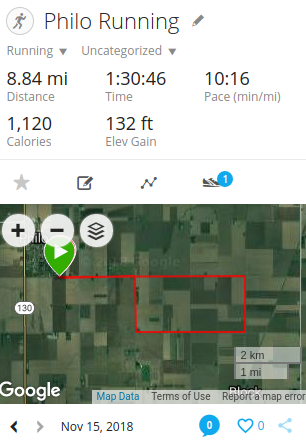
Run 2018-11-15I was able to complete my 8+ miles at a slow pace, but it was a good workout, and I’m very grateful to be able to get out there and run even if the conditions are a little rough.

My feet were a little wet from the snow melt, but they weren’t too cold or uncomfortable.

Stay warm, run strong!
What about injuries?

grayscale photo of man

Photo by rawpixel.com on Pexels.com

When is everything just fine? Seldom ever!

If I think about it, there is some pain somewhere in my body every day. When you’re a runner there are common areas that can ache (or worse) regularly; then there are those pain points that you can’t ignore.

Get to know your body parts at least at the high-level, so you know what hurts and what you may be able to do about it.

Know your buttocks! This may sound funny or the start of a joke, but for the runner having an understanding of what all connect in that part of your body can be helpful. I know I’m not alone in saying the sciatic nerve and piriformis muscle can be a pain in the backside.

In your legs be aware of the quads and hamstrings of the upper leg, the knee area (for example the MCL, ACL, LCL), the lower leg with the tibia bone as the main support and fibula as the smaller bone structure, and the Achilles tendon running down the back of the leg to the heel. In your feet get to know the plantar group which runs across the bottom from the heel forward. These are my primary points of attention.

There are a lot more muscles and technical information available. If I can toot my company’s own horn for a moment, I like the book “Running Anatomy” by Joe Puleo and Patrick Milroy in our collection of Running Books here. As of this post, the 2nd edition is available. What I like about this book is that it contained some technical information and structures for practical application for the non-anatomy-expert.

The rest of your body is involved in running as well. I was surprised how I injured my rib cage and shoulders while running! I’ll talk about the head and the impact of our thinking in a different post. I mentioned in another post about my non-running exercise; these upper body injuries are the reason I do the extra workout. Be sure to keep your torso strong and flexible to make your running more effective and enjoyable.

Do I stop exercise when I have an injury? No, I compensate.

For example, when I separated some ribs, it became challenging to take a deep breath thus making a full run out of the question, but I could power walk and walk I did!

With leg, knee, ankle, and foot issues, I find ways to compensate for the pain or injury. This may include less aggressive speed, reduced difficulty routes, a change in gait which often includes a change in the foot strike zone. Whatever I can do to keep moving. This tactic has worked well over the years. A note of caution – oft times when compensating for one injury you can create another pain point, be sure to pay close attention to what hurts!

You may want to consider Pilates, Yoga, or other massage and stretching therapies. Here is a great resource from a Physical Therapist and Pilates expert on dealing with pain and injury.

Listen to your body, but don’t stop moving.

Do I always want to run?

woman sitting on rock

Photo by Camargo Anthony on Pexels.com

The short answer is no!

Some mornings it is hard to get out of bed and face the cold or the heat or to deal with an injury or a sore muscle.

Like everyone else, some days I would rather sit by the fire with a hot cup of tea or coffee while snacking on something sweet. Or cuddle up in something warm and soft while binging on movies.

But I don’t! I get up and get it done. It’s not really a negotiation, it’s what I do. If there is a decision to make then I have a chance of getting it wrong, so it’s not something to decide, I just do it.

What are your non-negotiable items?

Bodily eliminations and running

When you gotta go, you gotta go!

This topic can be a bit sensitive depending on how you handle it. When you’re a long distance runner, sometimes you need to relieve yourself along the way. When you’re far away from others in the fields or woods, you have some flexibility, but if you’re in town, you need to be a bit more strategic. Men also have a little more flexibility than women here at least for the urination side of elimination. I should state that I’ve known some females that can pee faster than men. 🙂

When I travel to regions out of my norm, I will try to map out routes and alternatives for the next morning. If the area is urban/sub-urban I make a note of where the public restrooms are located should the need arise.

I’m primarily addressing the need to urinate during a run. However, there have been just a few times where the bowels have launched a full-scale attack mid-run. Gas station bathrooms are far from my favorite places, but when your bowels are screaming, they look like a beautiful thing. It’s amazing how low your clean-freak standards drop when your options for relief are extremely limited.

I saw this article last year which adds some additional perspective on this topic.

Most places have decency standards and think about how you’d feel if someone was relieving themselves in your front yard. Plan ahead, have a backup plan, be courteous and civil, then enjoy your run!

Food and Drink on the Run

I carry a 20oz water bottle on my running belt (similar model) for hydration. I rarely need it during the cooler parts of the year, but I always carry it. As I mentioned in a different post, I use water to curb hunger pangs if they occur on a 10-mile run or less. During the hot summer months, I can easily drink most of it during my normal 8-9 mile runs.

Why water? When I first was able to actually run more than 2 miles, I read about electrolytes, sugars, and other nutrient deficits that can occur while running so I tried a few “sport” drinks in my bottle.

  • First, they really didn’t seem to help revitalize or refresh while running.
  • Next, the bottle can get sticky and can leave stains (on everything).
  • And the waste was glaringly evident. If you don’t drink it all, how long would you leave it in the bottle? Is it still consumable after being in high summer temps mixed with your sweaty lips and saliva? Eww…

Anyway, I found that sticking with water not only provided the refreshment needed, but it was also easier to deal with. Plus, on those long runs, it’s easier to find replacement water from a park or gas station than dealing with the time and hassle of money to buy something.

What about food?

Most of the time I don’t need it, but on those crazy days when I’m going for a run greater than 10 miles, I put some Medjool dates in a cheap baggie and drop them in my pocket.

About the 7 mile mark, I’ll eat a date with a drink of water, then repeat every other mile. I have found this is sufficient nutrition to maintain a run without feeling poorly during or after. My longest run at this point is a little over 15 miles, and this worked well.

I have tried other foods as well – energy bars, granola bars, nuts, etc. However, for me, those are harder to consume while running. It is very easy to choke on anything that can break apart when you’re chewing because you’re also breathing more while in motion. The dates are softer, chewy, can easily sit under your tongue while getting an extra breath, and are packed with natural goodness.

Page 17 of 20

Powered by WordPress & Theme by Anders Norén